
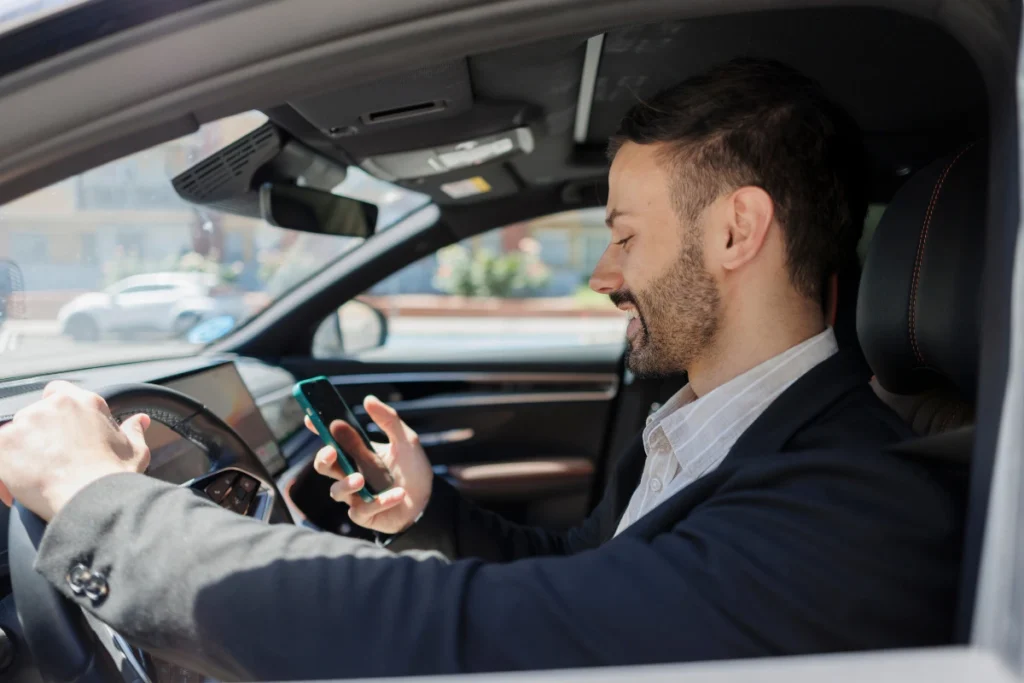
A driver glances at a phone, misses a traffic signal, or looks away just long enough to hit another vehicle. If you were injured in a crash like this, a distracted driving accident lawyer Burbank residents can consult may help you understand what evidence matters and what options may be available. Distracted driving is not limited to texting; it includes actions that take a driver’s attention away from the road. This guide explains how distraction may affect fault, which California laws apply, how to document your injuries and losses, and when legal guidance may help you make informed decisions about an injury claim.
1. What Counts as Distracted Driving in California?
Distracted driving occurs when a driver’s eyes, hands, or attention move away from the task of driving. It can involve a phone, an in-car screen, eating, adjusting controls, or focusing on something happening outside the vehicle.
The California Office of Traffic Safety identifies three broad types of distraction:
- Visual distraction: Looking away from the road.
- Manual distraction: Taking one or both hands away from driving.
- Cognitive distraction: Thinking about something other than the driving task.
Some activities involve more than one type. Texting while driving, for example, can require a driver to look at a screen, use their hands, and shift their attention to the message.
California’s official traffic-safety guidance explains that distracted driving includes activities that take a driver’s eyes, hands, or mind away from driving. Learn more from the California Office of Traffic Safety.
Example: A driver approaching an intersection looks down to read a notification. If the driver misses a red light and collides with a vehicle proceeding through the intersection, the phone use may be relevant evidence when investigators evaluate how the crash occurred.
Not every distraction automatically proves legal responsibility. The evidence must connect the driver’s conduct to the collision and the harm being claimed.
2. How Can Distracted Driving Cause a Car Accident?
Driving requires attention to changing traffic conditions, pedestrians, cyclists, signals, and the actions of other road users. When a driver looks away, takes their hands off the wheel, or becomes mentally distracted, they may fail to respond appropriately to a developing hazard.
Common examples include:
- Texting while driving: A driver looks at a message instead of traffic slowing ahead.
- Using navigation: A driver enters an address while approaching a busy intersection.
- Adjusting vehicle controls: A driver focuses on a screen rather than a merging vehicle.
- Reaching for an object: A driver bends down to retrieve a dropped item and drifts into another lane.
- Looking at passengers or roadside activity: A driver fails to notice a vehicle stopping or a pedestrian entering a crosswalk.
These situations may contribute to rear-end collisions, intersection crashes, sideswipes, pedestrian injuries, and motorcycle accidents. The actual cause of any collision must be assessed using the available evidence.
Why does this matter for an injury claim?
A distracted-driving injury claim generally needs evidence about how the collision occurred, whether the driver acted negligently, and what injuries or losses followed.
For example, a driver who strikes a stopped vehicle after looking down at a phone may have acted negligently. Witness observations, vehicle damage, available video, and the collision report may help investigators or insurers evaluate that account.
If you were injured in a crash, the firm’s car accident legal services provide a relevant starting point for learning about accident claims.
Want to understand your options? You can request a free consultation to discuss your circumstances with the Law Office of Egishe Avetisian.
3. What California Laws Apply to Distracted Driving?
California restricts handheld cell phone use while driving. Under California Vehicle Code section 23123.5, drivers generally may not hold and operate a handheld wireless telephone or electronic wireless communications device while driving, subject to statutory exceptions and specific conditions for permitted use.
The law allows certain hands-free operation. It also provides limited circumstances in which a mounted device may be operated with a single swipe or tap, provided the statutory requirements are met. Drivers should not assume that mounting a phone makes every form of use lawful.
California also restricts handheld phone use for adult drivers under Vehicle Code section 23123, with exceptions provided by law. Drivers under 18 face additional restrictions on wireless telephone use while driving.
You can review the state’s distracted-driving guidance and California Vehicle Code section 23123.5.
Does breaking a traffic law automatically prove an injury claim?
No. A violation may be relevant evidence, but a civil injury claim still requires an assessment of the applicable legal rules and the facts. The question is not simply whether a driver used a phone; it is whether the evidence establishes the elements of the claim, including the connection between the conduct and the injuries.
Example: If a witness reports seeing a driver holding a phone before a collision, that account may be relevant. Investigators would still need to examine the other evidence, including the timing of the event and how the crash occurred.
A lawyer can help explain how the facts and any available evidence may affect your claim.
4. How Can You Prove the Other Driver Was Distracted?
Distracted driving can be difficult to establish because a driver’s attention may not be visible after the collision. You do not necessarily need one perfect piece of evidence; several consistent sources may help build a clearer picture.
Potentially useful evidence includes:
- Witness statements: Someone may have seen the driver looking down, holding a phone, or failing to respond to traffic.
- Dashcam or surveillance footage: Video may show the events immediately before the collision.
- Police or collision reports: Reports may document observations, statements, and information gathered during the investigation.
- Photographs and physical evidence: Vehicle positions, damage, road markings, and traffic controls may help explain the sequence of events.
- Available phone-related evidence: Relevant records may sometimes help establish device activity, subject to legal requirements and access restrictions.
- Medical records: These may document the injuries and treatment that followed the collision.
You should not try to access another person’s phone, accounts, or private records yourself. Preserve the evidence you lawfully possess and let appropriate investigators or legal professionals address other evidence that may be relevant.
What if there is no video?
A claim is not automatically impossible just because there is no recording. Witness testimony, the collision circumstances, physical evidence, and other reliable information may still help establish what happened.
For example, a pedestrian struck near a Burbank intersection may have a witness who saw the driver looking at a phone. Nearby businesses may also have cameras, although footage availability and retention vary.
Write down what you remember as soon as practical, including the time, location, traffic conditions, and any statements you heard. Keep the details factual and separate what you personally observed from what someone else told you.
5. What Should You Do After a Distracted Driving Accident?
After a collision, you may be worried about pain, transportation, missed work, and insurance calls. Start with your health and safety, then preserve information that may help document the crash.
- Check for injuries and immediate danger. Call emergency services when needed and move to a safe location if possible.
- Get medical attention. Seek an evaluation for injuries or concerning symptoms, even if you are unsure how serious they are.
- Contact law enforcement when appropriate. Report the collision and provide an accurate account of what happened.
- Collect available information. Exchange details with the other driver when possible and obtain witness contact information.
- Photograph the scene. If safe, capture vehicle damage, traffic controls, road conditions, and relevant surroundings.
- Notify your insurer. Follow the reporting requirements in your policy and keep a record of communications.
- Organize your records. Save medical documents, repair estimates, receipts, and any correspondence about the collision.
California DMV guidance states that a driver generally must file an SR-1 report within 10 days if a collision results in injury or death, or property damage exceeding $1,000. This report is separate from a police report or insurance notification. Check the California DMV’s SR-1 reporting instructions to determine whether the requirement applies to your situation.
Example: If a driver hits your vehicle at an intersection and you suspect phone use, record the location and any witnesses’ observations. Do not delay medical care or put yourself at risk trying to obtain evidence.
If you have questions about documenting a crash or handling an insurance claim, you can contact the firm for a consultation.
6. What Compensation May Be Available After a Distracted Driving Crash?
Depending on the facts, the injuries, the available insurance, and applicable law, an injury claim may seek compensation for losses caused by the collision. No particular type or amount of compensation is guaranteed.
Potential categories may include:
- Medical expenses related to the injury.
- Future medical care when supported by appropriate evidence.
- Lost income and, where supported, reduced ability to earn.
- Physical pain and emotional distress associated with the injury.
- Other legally recoverable losses supported by the evidence.
Damages is the legal term for money sought to compensate a person for legally recognized harm or loss.
For example, someone who requires medical treatment and misses work after being hit by a distracted driver may keep medical bills, appointment records, and employer documentation. These records may help establish the losses being claimed, but the insurer or court will assess the evidence and applicable legal standards.
Insurance coverage can also affect what may be recovered. A driver may have liability insurance, while the injured person may have other relevant coverage under their own policy. The available options depend on the circumstances and policy terms.
7. When Should You Contact a Distracted Driving Accident Lawyer in Burbank?
Not every collision requires a lawyer. If the damage is minor, nobody is injured, and the insurance process is straightforward, you may choose to handle the matter directly.
Legal guidance may be worth considering if:
- You suffered an injury or need ongoing medical care.
- The other driver denies using a phone or disputes fault.
- The insurer questions whether your injuries were caused by the crash.
- You are asked to accept a settlement you do not fully understand.
- You have lost income or anticipate additional treatment.
- You need help understanding evidence, coverage, or legal deadlines.
If a commercial truck was involved, the investigation may raise questions about the driver, employer, and other potentially responsible parties. You can learn more about the firm’s truck accident legal services.
If you were riding a motorcycle when a distracted driver caused a collision, you may also want to review the firm’s motorcycle accident legal services.
A distracted driving accident lawyer in Burbank may be able to review the available information, explain the claims process, and help you understand possible next steps. A consultation is an opportunity to ask questions; it is not a guarantee of a particular outcome.
Frequently Asked Questions
How can I prove a driver was texting when they hit me?
Potential evidence includes witness accounts, available video, collision reports, and other records lawfully obtained during an investigation. You do not need to obtain another person’s private phone records yourself. The evidence must be assessed together to determine what it shows about the driver’s conduct and the cause of the collision.
Is texting while driving illegal in California?
California generally prohibits drivers from holding and operating a handheld wireless telephone or electronic communications device while driving, subject to statutory exceptions. Certain hands-free uses are permitted under specific conditions. The precise rule depends on the driver’s circumstances and the type of device use, so check current California law.
Can I make a claim if the distracted driver denies using a phone?
Possibly. A denial does not by itself determine fault. Witnesses, video, collision evidence, and other reliable information may help establish how the crash happened. Whether a claim succeeds depends on the applicable law and the evidence connecting the driver’s conduct to your injuries and losses.
What if I was partly responsible for the accident?
California generally follows comparative-fault principles, which can allow responsibility to be divided among parties. An injured person’s recoverable damages may be reduced according to their share of fault. How this affects your claim depends on the circumstances and the applicable legal rules.
How long do I have to file a distracted driving injury claim in California?
Legal deadlines depend on the type of claim, the parties involved, and other circumstances. Different rules may apply when a government entity is involved. Do not assume that reporting the crash to police or filing an insurance claim extends a lawsuit deadline; seek legal advice promptly if you are unsure.
Understand Your Options After a Distracted Driving Accident
Being injured by a distracted driver can leave you managing medical care, expenses, and uncertainty about what happens next. Preserve the evidence available to you, follow applicable reporting requirements, and keep records of your injuries and losses.
If you are looking for a distracted driving accident lawyer in Burbank, the Law Office of Egishe Avetisian can discuss your circumstances and help you understand potential next steps.